Broker guide
Vow Mortgage Aggregator for Brokers 2026
Assess the Vow aggregator's percentage and transaction models, VOWNET, lender access, compliance support, trail, data and exit terms.
- Published
- Updated
The Vow aggregator is now presented publicly as Yellow Brick Road (YBR) Aggregation, with percentage and transaction models for mortgage brokers. Its fit depends on your commission profile, licensing arrangement and the agreement’s rules for your loan book and client records.
The decision starts with a distinction: a trading brand, a credit licensee and the company signing your aggregation agreement can have different names. Resolve those roles before comparing the two commercial models.
Confirm Vow’s Current Aggregation Identity
As at October 2026, YBR Aggregation’s website describes the business as formerly Vow Financial. You will still see Vow Financial and VOWNET in the group’s public pages and systems.
Vow’s website and public broker portal identify Vow Financial Pty Ltd, Australian Business Number (ABN) 66 138 789 161, Australian credit licence 390261. The YBR Aggregation website names Yellow Brick Road Finance Pty Limited, Australian Company Number (ACN) 128 708 109, licence 393195, in its credit-services footer.
Those disclosures identify different legal entities. Neither footer alone establishes the counterparty to a new broker agreement.
Use the names according to the task you are completing:
| Task | Public name or destination | Document to match during onboarding |
|---|---|---|
| Enquiry and business-development support | YBR Aggregation, with Vow wording still present | Offer addressed to your brokerage and named contracting entity |
| Credit authorisation | Own licence or representative arrangement advertised by the group | Written authorisation naming the licensee and permitted activities |
| Client and application work | VOWNET | Platform terms and access arrangement for your team |
| Commission administration | Commissions Login points to the Vow broker portal | Commission schedule and nominated payment entity |
| Privacy and group services | Yellow Brick Road group names | Broker data clauses, privacy notices and service-specific terms |
The public portal retains the Vow brand, while the newer aggregation site uses YBR. A mixed set of names does not itself establish a change to your existing contract. For a new agreement, have the provider identify the contracting company and authorising licensee in the offer, then match them to the signature page.
The group privacy policy defines its scope through Yellow Brick Road Holdings Pty Limited, related bodies corporate and credit representatives. That is a privacy-policy description, not a promise that the holding company signs your aggregation contract.
Compare Vow’s Aggregation Models
Vow publicly describes a volume-tiered percentage model and a transaction model charging by settlement and trail transaction. Compare them using identical loan activity and the proposed schedules, including goods and services tax (GST).
Under a percentage model, the amount you retain depends on the commission split and the tier rules. Under a transaction model, the number of chargeable events affects cost. A substantial existing trail book can produce many monthly transactions even during a quiet settlement month.
Use One Fictional Brokerage Profile
Consider an illustrative brokerage that settles 60 loans of $500,000 each in a year, totalling $30 million. Assume annual gross upfront commission of $180,000 and gross trail of $60,000, both excluding GST. These are fictional inputs, not lender commission rates or a Vow offer.
Assume 200 existing loans each produce one chargeable trail transaction every month, giving 2,400 transactions annually. Keep that count fixed in both models. Add new-loan trail transactions separately if the proposed schedule charges them during the year.
| Comparison input | Percentage model | Transaction model |
|---|---|---|
| Gross upfront commission | $180,000 before the agreed split | Same $180,000 before deductions |
| Gross annual trail | $60,000 before the agreed split | Same $60,000 before deductions |
| Upfront deduction | $180,000 multiplied by the aggregator’s retained share | 60 multiplied by the confirmed settlement charge |
| Trail deduction | $60,000 multiplied by the aggregator’s retained trail share | 2,400 multiplied by the confirmed trail-transaction charge |
| Other annual charges | Add every fixed or activity charge in this offer | Add every fixed or activity charge in this offer |
| Annual amount retained | $240,000 less all model deductions | $240,000 less all model deductions |
If commission tiers change during the year, calculate each period separately. Use the schedule’s definition of volume: dollars settled, loan count and commission received can produce different tier outcomes. Also establish whether a higher tier applies retrospectively or only to later settlements.
The transaction model has a financial advantage only when its combined charges are lower for the same commission and service profile. A percentage model can be competitive where the retained share is low or included support offsets separate charges. Neither label establishes the cheaper choice.
Resolve the Offer’s Charging Rules
Have both proposed schedules specify upfront and trail shares, tier thresholds, settlement charges and trail-transaction charges. Record minimums, clawback administration, software access and the cost of additional users. Specify whether GST is included or added, then compare both models on the same tax basis.
Define a chargeable trail transaction, including split payments and adjustments. Establish whether dormant accounts attract charges and how the provider changes rates or reviews volume tiers. Keep paid compliance, marketing and training services separate from included aggregation support.
For broader calculations, use the mortgage aggregator fee guide. A Vow decision still turns on the schedules attached to your own agreement.
Test VOWNET and Lender Access
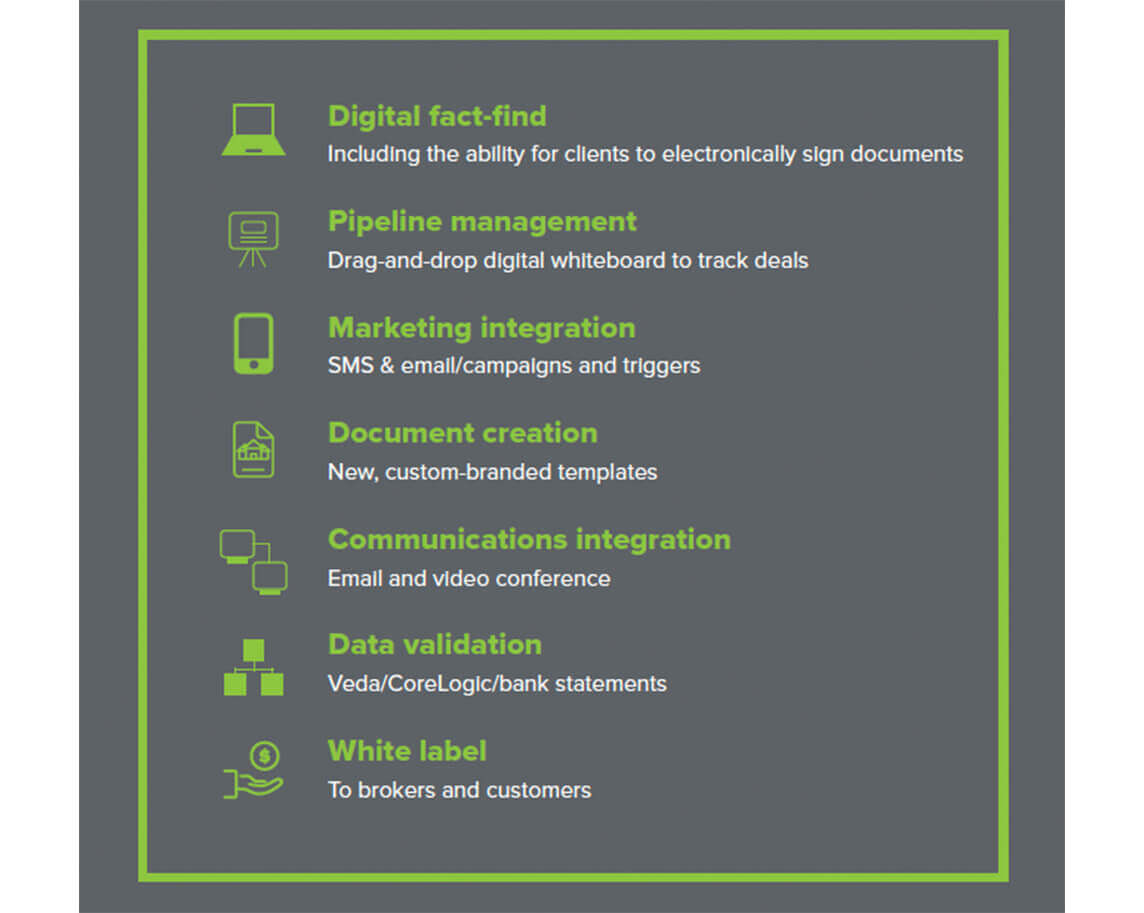
VOWNET is the group’s customer relationship management (CRM) platform for broker files and workflow. Its published feature graphics describe a digital fact-find, electronic signatures, document templates, a deal pipeline and communications tools.
The VOWNET feature graphic is useful for mapping those jobs. The group’s takeaway graphic describes VOWNET as Salestrekker-based, with application-process automation. Treat the following as an onboarding demonstration agenda, with each output tied to your team’s responsibilities.
| Workflow | Published description or public route | Output to establish in onboarding |
|---|---|---|
| Client records | Digital fact-find and electronically signed documents | Completed client record, permissions and retained attachments |
| Research | Feature graphic names data-validation services | Current research tools, source dates and any separate subscriptions |
| Compliance | Compliance graphic describes processes integrated into VOWNET | Assessment record, file notes and audit access |
| Application work | Pipeline tracking and application-process automation | Supported submission route and responsibility for lodgement. Establish how status updates reach the client record. |
| Reporting | Pipeline tracking is described publicly | Team reports, commission reports and export formats required by your business |
| Commission administration | Separate Commissions Login points to the Vow portal | Reconciliation from lender payment through deductions to the broker statement |
A pipeline board helps track a file, but it does not by itself prove a lender connection or a commission-reporting function. In onboarding, establish where each job occurs and who maintains the record. Use a fictional file for demonstrations so client information stays out of an evaluation session.
As at October 2026, Vow’s public description includes residential, commercial, asset and personal lending access, plus specialist lenders. YBR’s newer aggregation page also names commercial lending and leasing. Treat these as lending categories, not automatic accreditation with every funder.
For the lenders your clients need, record whether you receive direct accreditation, referral access or assistance from a specialist team. Identify experience requirements and any separate accreditation for commercial or asset lending.
Panel presence means the aggregator has a relationship. Your permission to lodge depends on your individual accreditation and authorisation.
Check Compliance and Business Support
Your licensing arrangement decides who supervises the credit work and which records the aggregator must receive. YBR publicly describes support for brokers using their own Australian credit licence (ACL) and brokers appointed as authorised credit representatives (ACRs).
With your own ACL, your brokerage carries the licensee obligations. Specify whether aggregation support includes file audits or compliance templates. Set out who owns remediation and reporting.
As a credit representative, you work under the authorising licensee’s supervision for the permitted credit activities. Specify mandatory workflow and file reviews, along with training and escalation. Establish the licensee’s access to client records.
The Australian Securities and Investments Commission (ASIC) explains that licensees must monitor and supervise credit representatives. Authorisation is for specified credit activities. Retain the written consent and establish which entity supervises you before accepting an appointment.
Under either arrangement, set out who keeps assessments and signed documents, and who can retrieve them during an audit or complaint. Compliance assistance does not transfer your client-file work to a support team. Specify the steps your broker and support staff must complete before lodgement.
Vow’s compliance graphic describes integrated processes, guidance from a dedicated team and training. The group also promotes state-manager support, marketing partners and a Broker Investment Program for loan-book purchases or exits. Turn each service into a defined inclusion before relying on it in your business plan.
For a new broker, the practical questions are induction, mentoring eligibility and who handles the first difficult file. An established own-licence brokerage needs clarity on audit support, team permissions and escalation. A diversifying brokerage needs a direct-versus-referral route for each lending category, with named support responsibilities.
For marketing services, separate supplied templates from paid design or campaign work. For training, establish how completion is recorded and whether specialist lending requires further training.
A Broker Investment Program is a reason to discuss finance or a sale structure. Eligibility and transaction terms decide whether it meets your needs.
Resolve Trail, Data and Exit Terms
The agreement must define what happens to your recurring commission and client records while you are a member and after you leave. Resolve these provisions before signing, even if your immediate plan is to grow within the group.
Use this agreement checklist to obtain a clause reference or written schedule for each item:
| Term | Point to settle |
|---|---|
| Trail entitlement | Recipient, deductions and conditions for payment during membership and after termination |
| Client-data control | Rights to use records, client communications and limits on group use |
| Exports | Included fields, attachments, file notes, format, timing and charges |
| Notice and termination | Notice period, termination triggers and when access changes |
| Restraints | Restrictions on client contact, recruitment or working with another aggregator |
| Live files | Who can lodge, update and settle files spanning the departure date |
| Loan-book transactions | Sale or transfer rights, consent requirements and treatment of any financing |
| Post-termination access | Access to statements and historical records for audits, complaints or commission disputes |
Trail entitlement and loan-book financing must work together. For example, a financed book purchase can introduce obligations beyond the ordinary aggregation schedule. Have those documents explain repayment, transfer consent and the treatment of trail if the brokerage exits.
Vow is a candidate for a brokerage that wants a choice of commercial models and support across several lending categories. A newer broker can favour the model whose tier rules and support match uneven settlement volumes. An established brokerage can favour transaction pricing when its settlement and trail counts produce a lower deduction under the written offer.
Those fit conditions also depend on acceptable licensing supervision, access to the required lenders and workable exit terms. Use the mortgage aggregator comparison for the wider shortlist. If you are transferring business, use the aggregator switching guide to sequence notice and live files after the agreement issues above are settled.